
Feminism: a recent name for an old problem:
The word feminism is only a recent term, whereas the word ‘patriarchy’ existed in greek terms =
‘the rule of the father’ originally used in herding societies in the Old Testament. (LeGates, 11)
Every institution in our societies are dominated by men like Gates state:
“The military, industry, technology, universities, science, political office, and finance, in short every avenue of power within society, including the coercive force of police... [rests] in male hands” (LeGates, 12)
The ability for women to move beyond religious and patriarchal ideologies within society happened in the 16th century, through science and the development of medical knowledge, especially the woman's body.
Prior to this men wrote about women and their bodies and psychosis based on 'fictions and dreams' (Carroll, 345) where everything the woman could do the man could do better. Women were always linked to seduction of evil, witches, prophecy etc. the feminine was something to be feared and blamed.
We will discuss that there are many instances that have been powerful in the evolvement of the position of women as a valued part of society, but science definitely made a contribution in the turning point, which soon became a revolution.
The three different waves of feminism
In history, the three waves of feminism, all differed in reasoning and momentum, as well as our current "fourth wave of feminism" have given women a new 'freedom of expression' as women have the opportunity to produce the media and find a medium to express themselves.
Evolutions in society have impacted women's rights. For example during the:
- Industrial Age
- (Information)Internet Age
The First Wave of Feminism: some global perspectives
The first wave of feminism affected both the western and the eastern countries.
The right to vote started as far back as 1848 when the 'Seneca Falls Declaration' was reached at the first women's rights convention which was attended to by 300 men and women.
This declaration was set to 'claim the natural equity of women and outlining the political strategy of equal access and opportunity' (Krolokke)
This is said to be the start of the suffragettes movement.
'the cult of domesticity' a byproduct of the Industrial Age, was questioned when the suffrogettes fought for the woman's right to vote.
Further, in Germany the first feminist movement groups were build in Germany due to the French revolution. In German the term“Frauenbewegung” means the movement of women to liberate themselves and fight for their equal rights this occurred from 1815 onwards.
This link is in German - but if you have Google Translate you will be able to get a basic understanding.
The fact that women in Germany had been able to obtain the right to vote before European and American women gave fuel to the Seneca Falls Declaration.
Sojourner Truth, an African American woman in the mid 1800's, attended public rally's and spoke about abolition alongside Melissa Stewart and Francis E.W. Harper as they were socially conscious and wanted equality for coloured women. Though, they were not as supported in the voice for their right to vote as there was a growing fear within black men in 'giving illiterate coloured women the power to vote'.
“Demands for institutional change became possible only when institutions were seen to be of human rather than of divine origin” (LeGates, …., p.9) This realisation triggered the second wave of feminism - as the Industrial Age was actually a step backwards for women as their role in society was seen to be in the home.
It wasn't till WWI (in the US) when women worked alongside war efforts to help with more than family obligations that saw them win the right to vote.


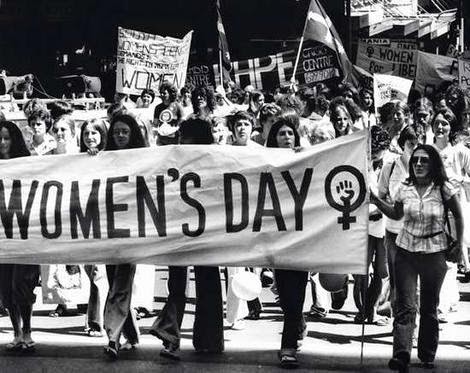
The Second Wave of Feminism
"women were a victim of a patriarchal, commercialised, oppressive beauty culture" (Krolokke, 2005)
"The term second-wave feminism refers mostly to the radical feminism of the women’s liberation movement of the late 1960s and early 1970s." (Krolokke,)
It focused more on Civic Rights in general. During the 1960's this was due to a growing global awareness of minority groups and inequalities within them.
It further created a separation of women from men in society.
'Sex and gender were differentiated—the former being biological, and the later a social construct that varies culture-to-culture and over time.' (Rampton, 2008)
Still various things which we are taking for granted nowadays for an offence if done by women. For example the case of Annette Kellerman who was arrested in 1907 (for indecency) for wearing a one piece figure hugging swimsuit.
Although, in the early 1920's anyone and everyone were arrested if they swum at the beach between 8am-8pm as employers were concerned workmen would skive off work.
This is another example of how people need to fight for things were are now taking for granted.

Gloria Steinman - editor of feminist magazine
The Third Wave of Feminism
"Born
with the privileges that first- and second-wave feminists fought for, third-
wave feminists generally see themselves as capable, strong, and assertive
social agents: “The Third Wave is buoyed by the confidence of having more
opportunities and less sexism” (Baumgardner & Richards, 2000, p. 83)
So third wave feminism isn't just about women from a certain class, race or colour; it is everyone, it includes men. The boundaries of the second wave of feminism are gone, it is inclusive, global.

The 3rd wave of feminism is now at the stage to allow women to be women in a man's world with the intelligence and inclusiveness that each gender can do either roles and that the enabling of choice to be made which isn't reflective on the expected gender to do it, e.g. parenting, but who is better suited to it.
The Fourth Wave of Feminism
This new collective spotlight on the inequalities of women, without the degradation of men, is to bring to light the fact that half of the intelligence is being used in political, education and business worlds.
This is a chance in history to not swing from patriarchal to matriarchal societies, again, but to find a balance in the middle.
This current wave of feminism is concerned with the empowerment of women to form an equal opportunity society.While the western world developed many new rights for women in our western societies over the years, there are still many problems around the world build on the inequality women face. In Arabian states women aren't allowed to drive, yet. You can discover various other inequalities across media and cultures if you follow our blog post. Feel free to comment and have your say!

Further, you can check out the Feminism by Country for specific information about single countries

Source:
This current wave of feminism is concerned with the empowerment of women to form an equal opportunity society.While the western world developed many new rights for women in our western societies over the years, there are still many problems around the world build on the inequality women face. In Arabian states women aren't allowed to drive, yet. You can discover various other inequalities across media and cultures if you follow our blog post. Feel free to comment and have your say!
Further, you can check out the Feminism by Country for specific information about single countries
Source:
References
Le Gates, M. …. In Their Time: A History of Feminism in Western Society. Psychology Press. http://books.google.com.au/books?hl=en&lr=&id=K5jDe38ll7IC&oi=fnd&pg=PR3&dq=history+of+feminism&ots=8U4dz0Whdg&sig=GyZbxqZQ4tM6iqsAh-qYfRxXdj0#v=onepage&q=history%20of%20feminism&f=false
Krolokke, 2005. Three Waves of Feminism. Gender Communication Theories and Analyses. http://www.sagepub.com/upm-data/6236_Chapter_1_Krolokke_2nd_Rev_Final_Pdf.pdf
Rampton, 2008. The Three Waves of Feminism. The Magazine of the Pacific University. http://www.pacificu.edu/magazine_archives/2008/fall/echoes/feminism.cfm
image 1; Suffrogettes. http://www.thenervousbreakdown.com/wp-content/uploads/2008/11/suffragettes_new_york_times_1921.jpg
image 2; Annette Kellerman - http://luxemodo.com/40-bizarre-historical-photos/
image 3; Miss Americ. http://understanding-feminism.wikispaces.com/Waves+of+Feminism
image 4; Gloria Steinman. http://www.prairiedogmag.com/get-dressed-riding-the-second-wave-on-i-w-d/#more-54526
image 4; Woman's Day. http://naamat.org.il/upload/(IMG)1195046669.jpg
image 5; Storygraph; http://alexandracorinth.com/2012/06/16/addressing-the-memes-and-a-certain-brand-of-feminism/
image 6; Sherly Sandberg - Lean In; http://epromanski.files.wordpress.com/2014/03/sheryl-sandberg-copy.jpg


